

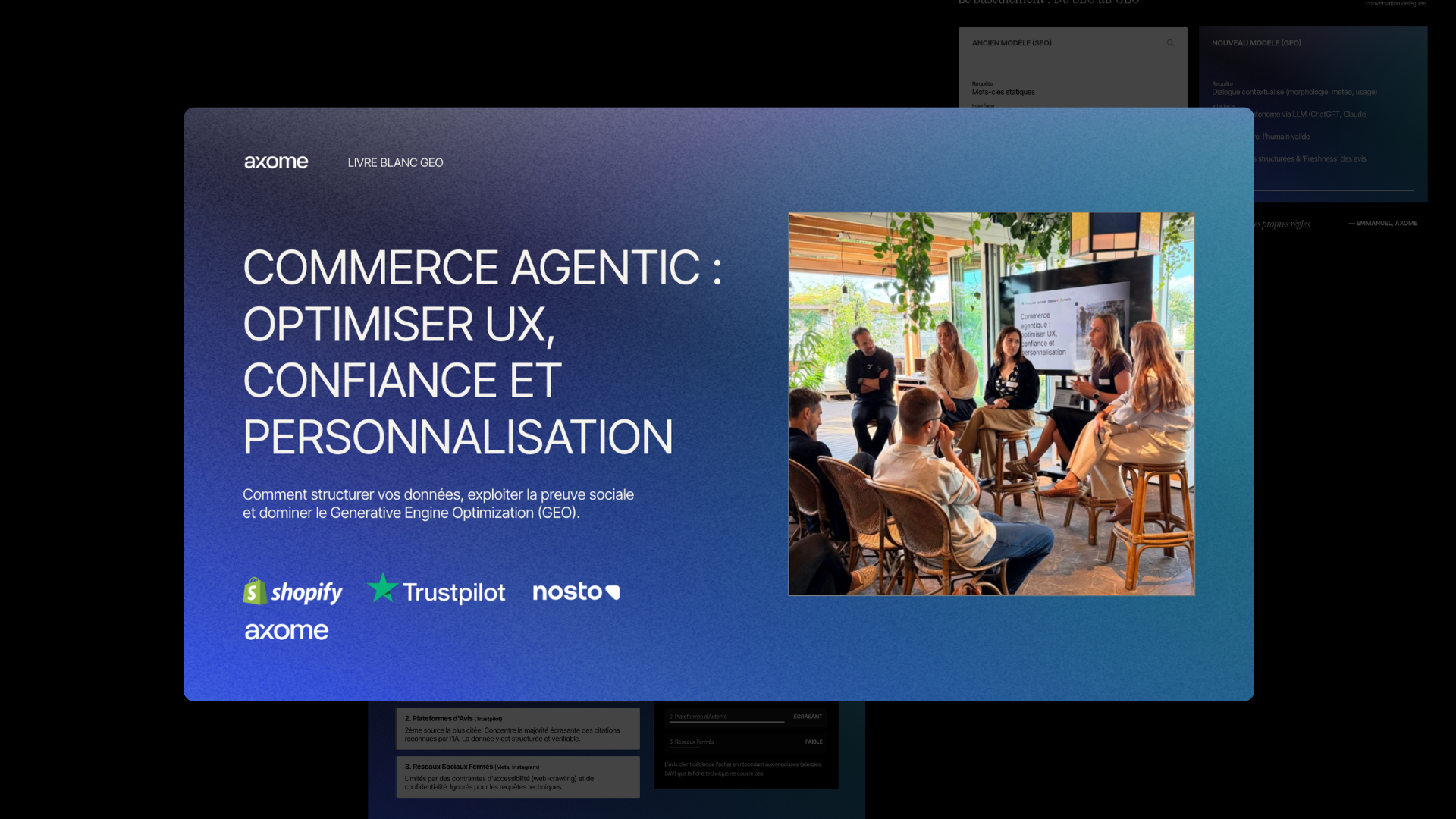
Trustpilot, Nosto, and Shopify discuss the importance of agentic commerce
Why is agentic commerce radically transforming the customer journey?
Agentic commerce replaces visual browsing with delegated conversation, reducing the average purchasing cycle from 15 days to 2 days for technical equipment. Buyers no longer manually explore catalogs: a conversational agent filters the offer based on their exact constraints, generating qualified traffic with a conversion rate that is twice as high.
Traditionally, the online purchasing journey follows a linear and fragmented pattern: keyword search on Google, browsing multiple results pages, site navigation, cart abandonment, retargeting follow-ups, and finally, conversion. This classic path often spans two to three weeks for products requiring thoughtful decision-making.
With the advent of Large Language Models (LLMs), the buyer now delegates the exploration phase to an autonomous assistant. Interaction is no longer based on a static keyword ("men's hiking jacket"), but on a highly contextualized dialogue combining body type, weather location, technical usage, and budget requirements.
This algorithmic filter performs massive pre-qualification upfront. As Emmanuel highlighted during the roundtable organized by Axome at Le Perchoir Porte de Versailles: "You must approach agentic commerce as a new sales channel with its own engineering rules." The user who clicks through to the store is no longer there to search: they have already validated the product's relevance within the conversational interface and arrive ready to finalize their transaction.
- Compressed buying cycle: decision-making time for technical purchases typically drops from 15 days to just 48 hours.
- Doubled conversion rate: visitors referred by an AI agent are twice as likely to purchase compared to the average organic traffic.
- A new selection dynamic: brands no longer dictate merchandising; instead, the algorithmic agent acts as the arbiter for the user.
What is the fundamental difference between SEO and GEO for an e-commerce brand?
SEO and GEO share the same goal—increasing brand visibility—but they serve different purposes. SEO optimizes a site's presence in search engines through keywords, tags, and domain authority. GEO, on the other hand, focuses on making an offering understandable and actionable for generative engines and AI agents.
The challenge is no longer just about ranking well for a query, but about providing information that is structured, precise, and verifiable enough for an AI to understand, compare, and recommend products within a specific context. Product attributes, metadata, data relationships, and recent reviews are becoming increasingly important.
At Axome, we believe GEO doesn't replace SEO; it extends it into an environment where search is becoming increasingly conversational and AI-assisted.
Why should you prioritize "specs" over "vibes" in your product descriptions?
Language models apply a strict precautionary principle: they remove any unverifiable subjective claims from their recommendations to avoid the risk of hallucination. A product page rich in technical specifications (certified materials, exact dimensions, real-world usage conditions) is systematically prioritized by the algorithm over purely emotional copywriting.
For years, digital marketing has championed emotional storytelling: "a sensational fit", "a magical look", "the ultimate style". While this approach remains useful for catching the human eye once they are on the site, it is completely ineffective for a generative engine. A language model has no mathematical benchmark to measure the magic of a garment or the charm of an accessory.
Sandra, a speaker for Shopify during the event, highlighted an unrelenting technical reality: "Taste and emotion are fine, but AI cannot afford to be wrong. A highly technical review will always be more respected." When in doubt, the algorithm chooses to hide a product rather than risk an incorrect answer.
Axome recommends adopting a compartmentalized data architecture:
- Break down descriptions: isolate each technical property into standardized meta-fields instead of burying specifications in a long paragraph of raw text.
- Leverage automated visual analysis: use native computer vision from e-commerce platforms to generate precise tags for finishes, materials, and cuts.
- Lock in your Tone of Voice: integrate proprietary terminology specific to your brand so that AI-generated content maintains your semantic identity rather than defaulting to generic descriptions.
How can asymmetry in your omnichannel feeds make your products invisible?
As soon as a generative engine detects a contradiction in price, stock, or description between your online store, a marketplace, and your centralized catalog, it triggers an immediate safety protocol. To prevent hallucinations or consumer complaints, the AI simply hides the product from its results entirely.
Data integrity is the fundamental prerequisite for algorithmic visibility. If your official site lists an item at €89 in stock, but a partner marketplace shows the same item as out of stock or priced at €99, the conversational agent faces a logical conflict that cannot be resolved without human intervention.
Faced with this information asymmetry, generative engines reject the product as a precautionary measure. To ensure your products consistently appear in responses from ChatGPT or Perplexity, your omnichannel synchronization must be flawless.
Axome helps merchants rigorously unify their data feeds. This process involves implementing a unified catalog within your sales infrastructure, supported by a high-performance PIM capable of distributing the exact same pricing and logistics data in real-time across all digital touchpoints.
Why do customer reviews now outweigh historical volume?
In generative search engines, recent collection dynamics take precedence over a historical stock of reviews. According to data analyzed at the conference, a brand with 50 to 200 recent reviews (collected within the last 48 hours to a few weeks) appears 60% more often in AI recommendations than a competitor sitting on 10,000 dormant reviews.
Artificial intelligence looks for tangible proof of a merchant's current reliability. An impressive volume of customer reviews from two years ago is no guarantee of current delivery punctuality, consistent build quality, or the current responsiveness of customer support.
To establish the relevance of a recommendation, agents rely on a precise hierarchy of information sources:
- Open sources and community platforms: LLMs prioritize exploring open text spaces (specialized forums, Reddit, YouTube) to capture raw user feedback.
- Certified trusted third parties: Authoritative platforms like Trustpilot are the second most cited source by AIs. Data there is structured, verifiable, and protected against manipulation.
- Closed social networks: Hermetic environments (Meta, Instagram) carry very little weight in technical queries due to indexing restrictions imposed on AI crawlers.
The presence of recent customer reviews solves a major challenge that technical specifications cannot address: it answers the buyer's contextual anxieties (size guides in real-world conditions, allergen tolerance, actual customer service effectiveness). To maintain this visibility, Axome recommends automating review collection at every stage of the customer lifecycle (delivery notification, product activation, renewal).
How can you convert traffic from conversational agents on your site?
To convert a visitor sent by a language model, the merchant site must immediately recognize their search intent and dynamically adapt its merchandising. Using semantic personalization engines like Nosto, the store adjusts its banners, reorders products by technical relevance, and emphasizes social proof.
Driving AI-qualified traffic to your store is pointless if you send visitors to a generic homepage or an uncurated product list. The user has made a specific request; their landing experience must instantly continue that conversation without any friction.
This is where an on-site semantic AI engine comes into play:
- Real-time vector personalization: the tool decodes the semantic intent of the visit to immediately display the specific technical variations sought (for example, prioritizing breathable, waterproof materials).
- Contextual session memory: the navigation remembers stated preferences to adapt campaign visuals and complementary product selections during subsequent interactions.
- Dynamic social proofing: prioritize five-star Trustpilot reviews for first-time visitors who need reassurance about brand credibility, while highlighting new technical features for returning customers.
This orchestration ensures that the effort invested in capturing attention through generative agents translates into measurable revenue from the very first touchpoint.
How do you balance AI autonomy with human expertise in customer relations?
A modern customer relationship relies on a hybrid approach: entrust an AI agent with the automated handling of routine, repetitive requests, while programming an immediate semantic escalation to a human advisor as soon as signs of friction or distress are detected.
The most common mistake Axome observes is delegating entire support operations to a conversational agent without rigorous guardrails. While AI excels at providing order status updates, guiding size selection, or recalling technical specifications, it becomes counterproductive the moment frustration sets in.
The semantic escalation method is structured across three levels:
- Level 1 (Autonomous AI Agent): instant 24/7 support for factual queries regarding catalog specifications, package tracking, and return policies.
- Level 2 (Semantic Intent Analyzer): continuous algorithmic detection of lexical tension markers ("disappointed," "problem," "urgent," "unacceptable") or sensitive cases requiring human expertise.
- Level 3 (Direct Human Handoff): seamless, instant session transfer to a customer service expert, who receives the full conversation history to provide a personalized solution without requiring the user to repeat themselves.
Conclusion: Turning the demand for clarity into a competitive advantage
Agentic commerce is not an obscure battle of secret algorithms; it is a radical demand for clarity and data verifiability. The retailers who dominate their market will not be those who accumulate the most marketing gimmicks, but those whose product data is immediately machine-readable and continuously validated by genuine customer feedback.
Axome supports executive, e-commerce, and marketing teams in designing digital architectures tailored for this new era. Whether your strategy relies on the transactional robustness of a unified e-commerce ecosystem or the agility of a brand ecosystem built on Webflow, our teams work across your entire value chain: PIM structuring, technical implementation, social proof integration, and AI-driven conversion optimization.
Contact Axome today to audit your catalog's GEO maturity and prepare your platform for the new standards of conversational commerce.