

What are the new features announced at Webflow Conf 2026?
With the arrival of the Source platform, the advanced integration of the MCP 2.1 protocol, and AEO features, Webflow is redefining visual development. Axome provides a factual breakdown and strategic vision for your corporate ecosystem.
What Webflow Conf 2026 changes for corporate websites
The Webflow Conf 2026 marks the definitive shift from visual development to Marketing Engineering and agentic automation. With the unveiling of Source by Webflow, the evolution of the MCP server to version 2.1, and the emergence of Answer Engine Optimization (AEO) tools, the platform is now directly targeting product teams and high-growth brands. For marketing and IT decision-makers, these announcements redefine execution speed without sacrificing technical governance.
What are the major announcements from Webflow Conf 2026?
Webflow Conf 2026 introduces six major developments: the independent Source by Webflow platform, the MCP 2.1 protocol with GSAP support, Agent Presence and Instructions 2.0 features, the Campaigns landing page generation tool, the Webflow Assets hub, and full branching with Releases.
These innovations aim to transform how companies design, iterate, and deploy their web interfaces.
Source by Webflow: toward the era of Marketing Engineering
The central surprise of this edition is called Source. It is not just a simple addition to the existing Designer, but a new, distinct product designed to bring code, headless CMS, CRO optimization workflows, and AI agents into a single operational environment.
Source offers a modular approach through the concept of Views : workspaces that can be customized according to the user's role (front-end developer, growth marketer, content creator, or conversational agent). Axome notes that this direction bridges the historical gap between the strict requirements of technical teams (versioning, direct source code, deployment on custom infrastructures) and the need for rapid autonomy expressed by marketing teams.
The product allows existing Webflow-developed sites to be integrated while opening up hosting to third-party cloud environments. For SMEs and mid-market companies managing complex ecosystems, Source outlines a credible alternative to headless architectures that are heavy and costly to maintain.
MCP 2.1: when AI manipulates the CMS and code without friction
The Model Context Protocol (MCP), initiated by Anthropic and adopted by Webflow, reaches a new milestone with version 2.1. This update resolves the technical bottlenecks of the first generations of AI connectors:
- Complex interactions via GSAP: Teams can now instruct an agent to implement a full dynamic animation using natural language while maintaining visual control over timelines and easing curves.
- Advanced CMS querying: The agent instantly filters and sorts items across custom and multi-reference fields, reducing token consumption during content audits.
- Webflow Cloud error management: Deployment logs and error reports can now be analyzed directly by environments like Claude Code or Cursor, enabling semi-automated troubleshooting and redeployment.
In parallel, the introduction ofAgent Presence displays AI action cursors on screen in real time, preventing workflow collisions between human collaborators and automations. The Agent Instructions 2.0 feature extracts the site's existing design system and editorial guidelines to inform the AI's context without repetitive manual configuration.
Campaigns, Assets, and Releases: streamlining the launch cycle
Producing advertising campaigns has historically been a bottleneck for many advertisers. With the Webflow Campaignsmodule, a simple strategic brief is all it takes to generate dedicated landing pages, audience variations, and associated visual templates in just a few hours.
To complete this workflow, Webflow Assets centralizes the brand media library under an AI-indexed search engine, facilitating automatic cropping and format variation (banner, social, and web header formats).
Finally, the Releases addresses a long-standing request from marketing departments: global site branching. Much like a Git branch, a team can prepare, modify, and get approval for the redesign of several strategic pages (pricing, global navigation, service pages) in an isolated environment before scheduling their instant publication to production.
How does Webflow integrate GEO and AEO in the face of AI search engines?
Webflow integrates Generative Engine Optimization (GEO) and Answer Engine Optimization (AEO) by providing semantic analysis agents capable of identifying queries where competitors are cited by AI, while automating the generation of llms.txt files and structured data essential for LLMs.
For B2B and B2C companies, visibility no longer depends solely on the first page of Google: it is now played out in the summaries provided by ChatGPT Search, Perplexity, or AI Overviews.
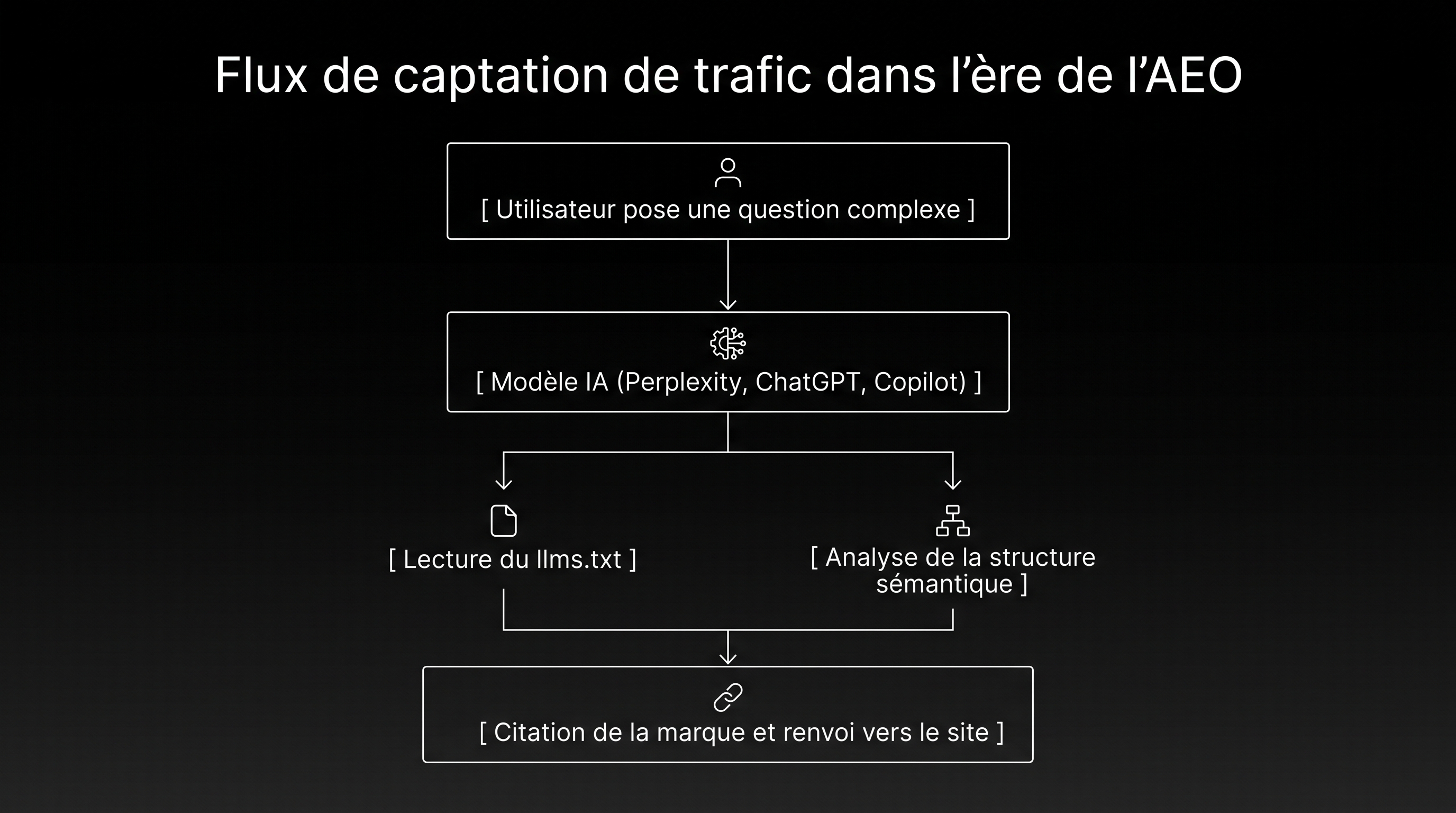
Identifying citation gaps against the competition
In its Enterprise version, Webflow now offers AEO monitoring agents. These tools scan the responses formulated by generative language models across a corpus of industry-specific questions. When a competitor appears as a preferred source at the expense of your brand, the agent identifies your site's informational gaps and suggests content structures to address them.
Axome's perspective on this shift is pragmatic: automated analysis does not replace true brand authority. While AI can suggest missing editorial angles, the added value lies in the credibility of the facts presented, field experience, and proprietary data that only your company possesses.
Technical standardization: llms.txt and entity schema
To be indexed and understood by a conversational agent, a website must provide an optimized reading architecture. Webflow simplifies the generation and updating of the standard llms.txt file, which summarizes the domain's informational map for AI crawlers.
Additionally, combining native CMS collections with comprehensive Schema.org markup transforms a simple blog post into a set of explicit data. It is precisely this semantic rigor that encourages engines like Perplexity to attribute the authorship of a response to your domain.
How can you reconcile a Webflow showcase site with an e-commerce platform?
The connection between Webflow and a dedicated e-commerce platform relies on a clear separation of responsibilities: brand experience, editorial content, and acquisition landing pages are managed in Webflow, while the transactional catalog, cart, and checkout rely on a dedicated engine like Shopify.
Many high-growth companies run into the limitations of monolithic architectures. The ecosystem presented at Webflow Conf 2026 reinforces the effectiveness of hybrid or composable approaches.
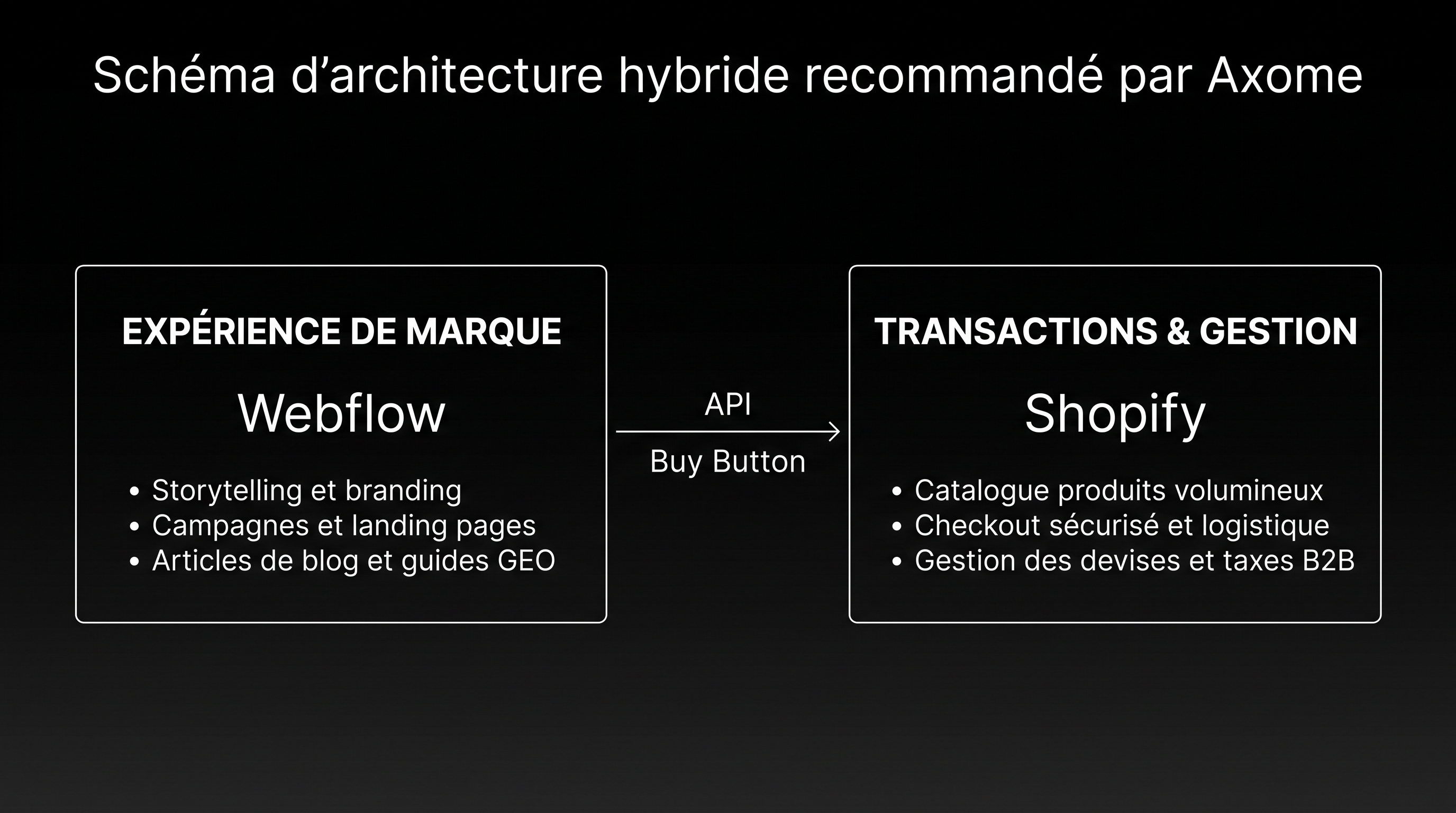
The optimal distribution of roles according to Axome
Trying to do everything within a single tool often leads to detrimental compromises:
- Acquisition and storytelling: Webflow excels at showcasing brand worlds, optimizing Core Web Vitals, ensuring editorial team agility, and rapidly deploying marketing campaigns.
- Transactional commerce: To manage advanced promotional rules, multi-warehouse inventory, multiple currencies, and a highly resilient checkout, the expertise of a certified Shopify agency remains essential.
Thanks to Webflow's APIs and third-party connectors, it is perfectly seamless to integrate purchasing components (Shopify Buy Button, synchronized carts) into a showcase site or a content platform built on Webflow. This architecture avoids the complexity of a full headless project while offering the best of both worlds.
Axome's analysis: why AI requires rigorous engineering
The increased accessibility of generative AI in creative tools comes with a trap: generating a mass of pages without structural coherence or adherence to front-end engineering standards. Axome's teams regularly point out that a site burdened by superfluous scripts, redundant CSS classes, or poorly calibrated API requests will degrade its Core Web Vitals signals (particularly Interaction to Next Paint, or INP).
The generation speed offered by solutions like Campaigns or MCP 2.1 does not replace:
- The implementation of a strict design system (utility classes, color variables, and standardized typography).
- Rigorous media optimization (WebP/AVIF compression, lazy loading).
- Governance of editing rights to preserve brand integrity in the face of automated generation.
How to prepare your company for new Webflow features?
To leverage the announcements from Webflow Conf 2026, start by auditing the technical structure of your current site, harmonize your design system variables, document your brand guidelines for AI agents, and test versioning with Releases on a pilot page.
Here is the methodical roadmap recommended by Axome to secure your deployments:
- Clean up the existing design system: Before connecting automation agents via MCP, standardize your CSS classes and convert your styles into global Webflow variables. AI only applies consistent instructions if the graphic database is structured.
- Define Agent Instructions documentation: Draft the editorial rules, tone of voice, vocabulary restrictions, and target personas that will guide your teams' conversational prompts.
- Establish a validation protocol (human-in-the-loop): Do not delegate direct publishing to autonomous agents. Use the separation of roles and the staging environments provided by Releases to visually and functionally validate every update.
- Configure semantic markup and AEO: Enrich each CMS collection with fields dedicated to structured metadata (FAQs, author attributes, entity relationships) to make it easier for conversational search engines to cite your pages.
The features unveiled at Webflow Conf 2026 confirm that the modern web belongs to organizations capable of combining visual creativity, intelligent automation, and engineering rigor. Whether you are planning a complete overhaul of your brand platform or modernizing your digital acquisition processes, the Axome team is here to help you turn these technological innovations into concrete, long-term growth drivers.